Performance Testing vs Load Testing: Key Differences Explained

Sam Atkinson is a results-driven SEO Executive with 3 Years of experience in optimizing digital visibility and driving organic growth. Skilled in developing and executing strategic SEO initiatives, Sam excels in keyword research, technical audits, and competitor analysis to elevate online presence and improve search engine rankings. With a keen eye for detail and a passion for delivering measurable results, Sam collaborates cross-functionally to align SEO efforts with business objectives and enhance website performance. Committed to staying ahead of industry trends.
Your application can handle 5,000 users and still deliver a poor user experience.
That's because knowing how much load your system can handle is different from knowing how that load affects app, device, and network performance.
This is where load testing and performance testing differ. Load testing generates expected traffic. Performance testing captures what that traffic means for the actual user experience.
What Is Performance Testing?
Performance testing checks how well an application performs. It looks at speed, stability, and how the system behaves under everyday use to extreme, unexpected situations.
The goal of performance testing is to tell if your software is fast, stable, and reliable enough for real users.
Performance testing usually measures performance across three layers:
App Experience: Speed, responsiveness, and reliability from the user's perspective, captured through metrics such as app launch time, response time, throughput, and stability.
Device Performance: The device-side factors that can influence the experience, including CPU, memory, and battery usage.
Network Performance: The connectivity factors that can make an app feel fast or slow, including latency, bandwidth, and network conditions.
What Is Load Testing?
Load testing evaluates how a system performs under expected levels of traffic and workload. It involves creating expected user activity such as browsing, searching, adding items to a cart, or completing a transaction to determine whether the system can handle the expected demand.
For example, if your online store usually gets 2,000 buyers during a sale, load testing checks whether your website can handle exactly those 2,000 people browsing, adding items to their cart, and checking out, all at the same time.
Performance Testing vs Load Testing: Key Differences
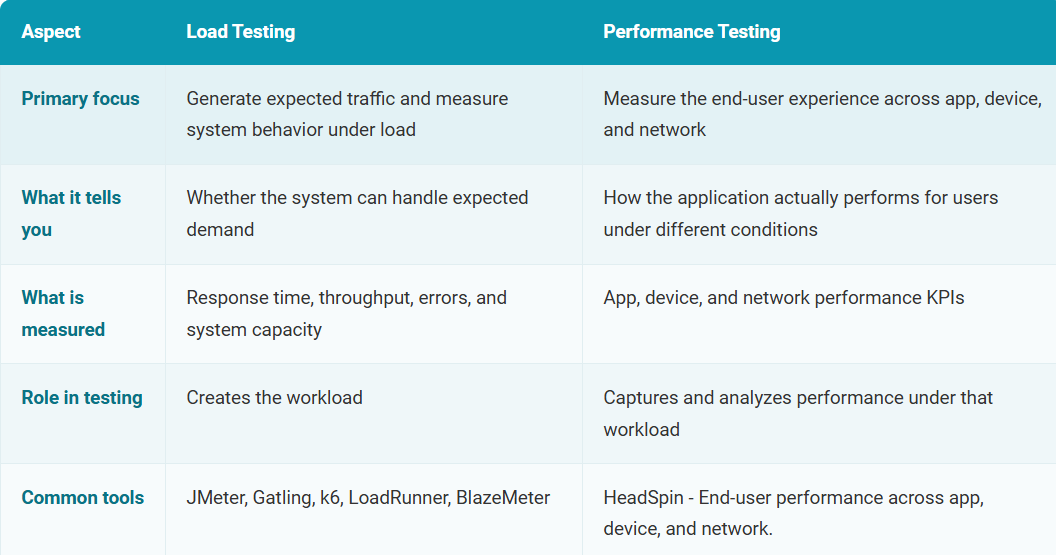
What Load Testing Tells You Is Only Part of the Picture
Load testing tells you whether your system can handle the expected workload. But passing a load test does not necessarily mean users will get a good experience.
To understand that experience, teams need to capture app, device, and network performance during those same load scenarios. This helps uncover issues such as slow app response, high device resource usage, or network-related delays that a load test alone may not reveal.
Performance Testing vs Load Testing Examples
A food delivery app is expecting 5,000 users during the evening rush. A load test can recreate that expected demand, but the team also needs to understand what that load means for the user experience.
Load testing example
The team uses a load-testing tool to create a workload representing 5,000 users browsing restaurants, placing orders, tracking deliveries, and making payments.
The test determines whether the system can handle the expected demand without excessive response times, errors, or failures.
Performance testing example
During the same 5,000-user scenario, the team captures app, device, and network performance to understand the experience users are getting under load.
They can identify issues such as slow app response, high CPU or memory usage, battery drain, or network latency that may affect users even when the system successfully handles the expected load.
The key difference
Load testing tells you whether the system can handle the load. Performance testing tells you what that load means for the user experience.
Common Types of Performance Testing
Performance testing includes several types of tests, each designed to evaluate how an application performs under a specific kind of demand.
Load Testing: Checks how the system behaves under expected levels of user activity and traffic.
Stress Testing: Pushes the system beyond its expected limits to find its breaking point.
Spike Testing: Checks how the system responds to a sudden, sharp increase in traffic or user activity.
Soak Testing: Checks how the system performs over a long period of continuous use to identify issues such as slowdowns or resource leaks.
Volume Testing: Checks how the system performs when handling large amounts of data.
Scalability Testing: Checks whether the system can continue performing well as the number of users, transactions, or data increases.
Load Testing and Performance Testing Tools
Load testing and performance testing serve different purposes, so the tools used for each play different roles.
Load Testing Tools
These tools are primarily used to generate virtual user load and evaluate how a system responds under expected demand.
1. Apache JMeter
Apache JMeter is a free, open-source tool for creating and running load tests.
Key Features:
Free and open source
Supports HTTP, FTP, JDBC, and other protocols
Large plugin ecosystem
GUI for creating tests and command-line execution for CI/CD
Best For: Teams that need a flexible tool for generating and executing load tests.
2. Gatling
Gatling is an open-source, code-first tool for creating and running load tests as code.
Key Features:
Test scripts can be written in Java, Scala, Kotlin, or JavaScript
Supports high numbers of virtual users
Generates HTML reports
Integrates with CI/CD workflows
Best For: Developer-focused teams that want load tests version-controlled alongside application code.
3. k6
k6 is an open-source, developer-friendly tool for creating load-testing scenarios using JavaScript.
Key Features:
Lightweight and easy to install
JavaScript-based test scripts
Built-in performance thresholds
CI/CD integration
Best For: Teams that want to automate load testing as part of development workflows.
4. LoadRunner
LoadRunner is an enterprise tool designed to generate load across complex applications and environments.
Key Features:
Broad protocol support
Detailed reporting
On-premises and cloud options
Best For: Large organizations testing complex or legacy environments.
5. BlazeMeter
BlazeMeter is a cloud-based platform for running large-scale load tests without managing load-generation infrastructure.
Key Features:
Cloud-based load generation
JMeter compatibility
Real-time reporting and dashboards
Best For: Teams that need scalable cloud-based load testing.
Performance Testing Tools
6. HeadSpin
HeadSpin provides the performance layer by measuring app experience, device performance, and network performance on real devices and networks.
Key Features:
Tests on real, SIM-enabled devices across 50+ global locations
Measures app, device, and network performance through KPIs such as app launch time, CPU usage, battery drain, and network latency
Regression Intelligence to detect performance regressions and help identify their root cause
Supports mobile apps, web, and OTT or smart TV platforms
Best For: Teams that need to understand the end-user experience under real-world conditions and load.
Why HeadSpin for Performance Testing?
Load-generation tools can tell you whether your infrastructure can handle a given number of users. HeadSpin adds the performance layer by capturing what those conditions mean for the actual user experience.
HeadSpin measures performance across app experience, device performance, and network performance on real devices and real networks. Teams can use these insights alongside load-testing scenarios to understand not just whether the system handles the load, but how the application performs while handling it.
Conclusion
Performance testing and load testing are related, but they are not the same thing. Performance testing evaluates application behavior across different conditions, including changes in traffic, device resources, and network quality. Load testing focuses on system behavior under a defined workload. Load testing is one part of that picture. It checks whether your system can handle the traffic you already expect.
Knowing this difference helps you plan your testing the right way. Instead of running one test and assuming your software is ready, you can build a testing strategy that actually matches how real users will use your product.
Originally Published: https://www.headspin.io/blog/performance-testing-vs-load-testing